
The Making of Matilda
How a Musical Comes Together
Every year students and teachers at Charlottesville Day School work on a play together. This year’s play is the musical Matilda, based on a book by Roald Dahl.
It tells the story of a very intelligent nine-year-old girl named Matilda Wormwood who uses her special powers against a mean school principal.
“We wanted to do something brand new that we’ve never done before,” says Jenn Thomas, a teacher who was the acting coach for the play. “It’s the biggest show we’ve ever done — it’s a huge undertaking.”
The Music
By Charlie Zahl (sixth grade)
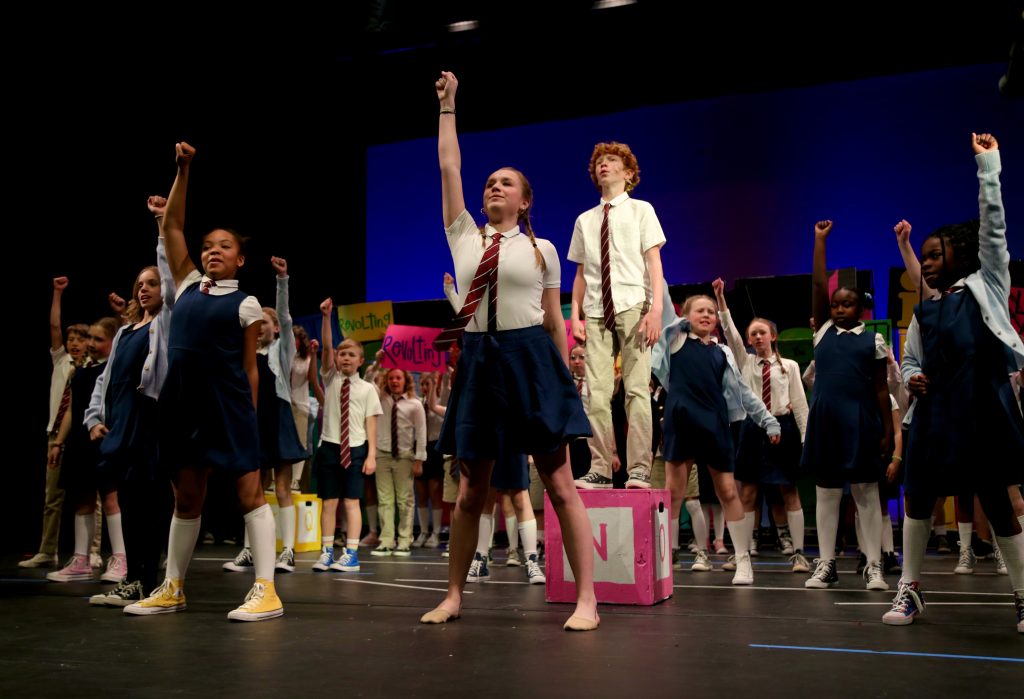
Matilda has various styles of music — Angela Kelly says, “It has a little bit of everything.”
She says the music is challenging, but that is also what makes it fun.
“The songs are actually really hard,” says Mrs. Kelly, who is the play’s music director. “There are so many fast-spoken words. Because we’re playing with a background track that has a set tempo, we do not have flexibility to change it to slower if we need to. We have to go to the fast tempo that the show is giving us, so that is super challenging. The other part that’s challenging and exciting is that the dance moves that we have are really intricate, advanced and involved. And so it’s hard to get all that right. But that’s the most fun and most challenging part.”
Mrs. Kelly is very proud of how hard all of the students have worked to put on a good show. “I think the audience will see how clearly invested each kid is because they have worked so hard and you’re going to see really high energy, passion and enthusiasm in this play,” she says. “You are going to be blown away by what these kids can do.”
Making Costumes
By Lucas Cao (sixth grade)
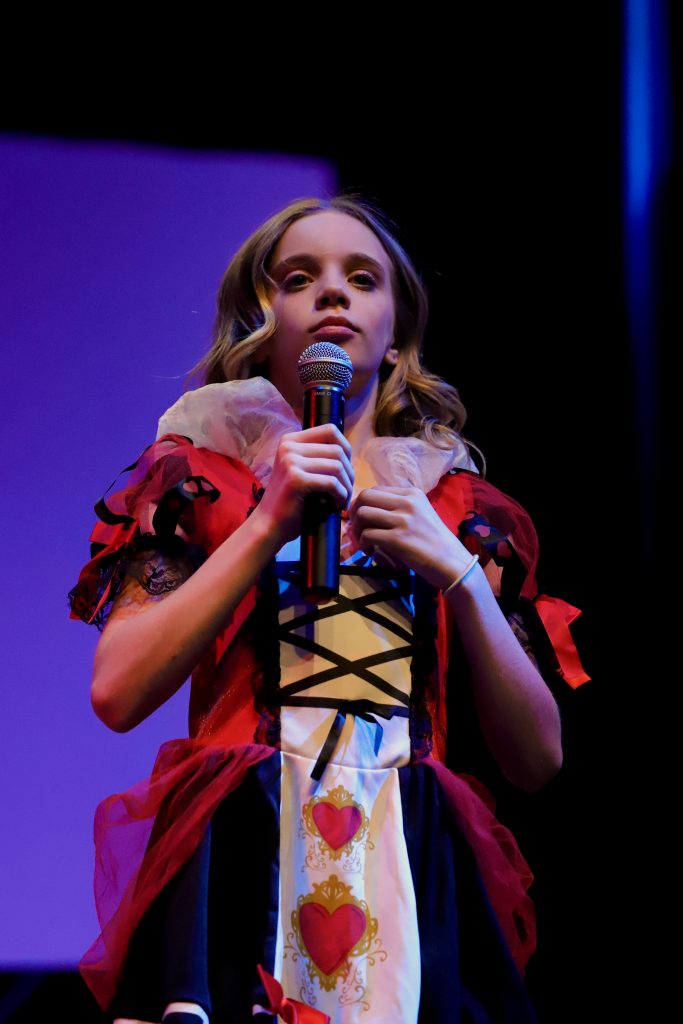
Making costumes for plays at CDS is usually something that students and teachers do together as part of an enrichment class. Teachers Karin Reed, Theresa Surry and Katie Hickson get creative ideas from the kids and look for inspiration online.
“The most-fun costumes we ever made were for the Lion King,” says Mrs. Reed. “We painted and we ripped fabric to make them. We usually go to Goodwill and get a whole bunch of used clothes and then we repurpose them. We cut, resew and use the hot glue gun a lot.”
According to Mrs. Reed, it takes a very long time to make the costumes, but she has a lot of fun making them with other teachers and students. They even work at night and on weekends. She says making the costumes has been a little bit different for Matilda than for some of the other plays. “The costumes are really for the kids school uniforms,” she says. “So you can’t be highly creative with school uniforms. They just are what they are.”
Mrs. Reed says that making costumes for Matilda has still been fun. “Our limited budget makes us very creative,” she says. “And we like to take our own creative bent.”
Building the sets
By Lucas Cao (sixth grade)
Sets are the scenery for a play. Making them takes a long time, but Theresa Sury says that it is a labor of love and she really likes it when students help paint the sets.

“One of the things that’s interesting about Matilda is the backdrop isn’t so specific to location,” says Ms. Theresa. “It’s more of a whimsical background that reflects things about Matilda — like the fact that she loves to read, so expect to see a lot of books on bookshelves and then giant alphabet blocks. We’re planning on building the Chokey (a device in the play used to punish students), which will be kind of fun and a little bit scary, perhaps.”
One of the best things about making the sets is seeing all the work come together at the end. “We spend a lot of time thinking about what they’re going to look like,” Ms. Theresa says. “We use ideas from the kids in the cast. There are a lot of hours put in outside of school but it’s so worth it. It’s so much fun to just see it all up there at the end of the day. We have the play at Piedmont Virginia Community College and it’s lit up with the lights from the theater. It’s just really rewarding and I feel very fortunate to be a part of it.”
Teaching Acting
By Sanders Miller (fifth grade)
Jenn Thomas is a second-grade teacher and the acting coach for all CDS productions. She knows a lot about acting because she was in her first play when she was 10 and later she went to acting school.
“As the acting coach, I have found the way I serve the rehearsals is to work on the story, because we always do musicals,” Ms. Jenn says.
“It’s my job to make sure we’re crystal clear on the story, and that we’re telling the story that we set out to tell. To me, acting is telling a story truthfully, under the imaginary circumstances. And that’s what I try to impart to my actors here at CDS.”
The Actors
Matilda
The role of Matilda is played by fourth grader Elizabeth Gartland. “The things that I like about the character of Matilda are that she really likes books and she doesn’t let anyone get to her,” Elizabeth says.
Elizabeth liked the challenges of having a big role, and she learned a lot about acting. “When you’re the main role in a musical, you have to speak really loud — basically scream,” she says. “You have to bring out your inner Matilda, or whatever character you’re playing. I think learning and memorizing all the lines is the most challenging thing because I have a line on almost every page. You also have to know when to say them.”
Watching Netflix was another way she learned more about the play and the characters. “The Matilda musical that Netflix came out with in December helped me memorize the Acrobat and the Escapologist story because I could see what they were doing.”
Ms. Trunchbull
Ms. Trunchbull is the mean and harsh headmistress at Matilda’s school. Eighth grader Alex Zimmerman played the role of Trunchbull and worked hard to create the unlikeable character. “I think the character is designed to be really disliked because it’s the main evil character, so obviously I’m not going to like the character either. Memorizing your lines is really difficult. Luckily, I’m not doing any dancing parts because I’m not a great dancer. If I did, then that would probably be the hardest part.”
Because Trunchbull is nothing like him, he thought that “the character would be way harder to adapt to than it actually is.” But Alex says he fit into the character faster than he thought he would.
Alex also learned a lot and has a piece of advice for people who are going to act in future plays at CDS. “Get off script as fast as you can,” he says. “Because once you’re off script, you can use your hands when you’re acting and move around, and you’re not staring down at your script the whole time. It just frees you up.”